Page 1 of 2 12 LastLast
Results 1 to 40 of 59

Thread: I didn't donate any money to Haiti

  1. #1
    Join Date
    Oct 2001
    Posts
    3,723

    I didn't donate any money to Haiti

    I've been catching some crap here and there about my beliefs here, and I really think people are way to sensitive about this. They fall into the politics of it and the celebrity press about it.

    Lets face it, Haiti was a very poor country before this quake. Residents lived in slums.

    I'm not against giving them aid, to get them on their feet. Give them medicine, bring them food, give them the opportunity to rebuild.

    But the country is full of poor, the government is not really ran the best.

    I read an interesting joke the other day:

    Q: Did you hear about the earth quake in Haiti?

    A: Ya, it caused 100 million in improvements.

    I just think we have our own problems right now. We are already funding and rebuilding Iraq, fighting a war in Afghanistan, now are we going to make Haiti our next project?

    We have a debt that went from 4 trillion to 12 trill in less than 10 years, and we are still giving away money. Now, tax payers are donating $10 each at a time of economic turmoil.

    I just don't see the sense of it, if my poor neighbors house burns down, and I'm 200k in credit card debt, I'll attend his benefit dinner, but I'm not going to rebuild him a better house.

  2. #2
    Join Date
    Feb 2009
    Posts
    5,750
    wordddddddd.

  3. #3
    Join Date
    Oct 2009
    Location
    USA
    Posts
    1,180
    Well their destruction was out of their hands. Better than Yemen who just recently told the U.N. they needed 4 billion in handouts just to keep their country running.

  4. #4
    Join Date
    Sep 2006
    Posts
    13,966
    Yes We Can!

  5. #5
    Join Date
    Dec 2009
    Location
    Mooneyville
    Posts
    691
    I didn't give any money either...

    U heard about them getting all the protein bars from the UN and throwing them on the ground and stomping them right? the bars that is, not the UN workers...

  6. #6
    I'm sorry these other countries dont have any money or the people have no power in government, but if they haven't gotten their shit together by now, sorry. Did Haiti send us any money during Katrina? Did soldiers from Iraq come here and help us rebuild? I'm sorry, but I could give a shit about countries that are hardly civilized, if a lone U.S. citizen was to walk down a street in Haiti they'd be kidnapped and have their head cut off. Yeah, exactly the type of country I'd like to help

  7. #7
    Join Date
    Oct 2001
    Posts
    3,723
    Quote Originally Posted by PistolStarta View Post
    Well their destruction was out of their hands. Better than Yemen who just recently told the U.N. they needed 4 billion in handouts just to keep their country running.
    I agree, it was out of there hands.

    I'm not saying we should ignore the fact they need help. I'm only saying, get them started.

    You can't turn a poor man to a rich man by just giving him a fortune.

    Give a poor man a million and he'll be poor in a few years.

  8. #8
    Yes, it def was out of their hands. But lets face it, shit happens. In the end the only one bailing you out of anything is you, bottom line

  9. #9
    Join Date
    Jan 2006
    Location
    New Joisey
    Posts
    7,947
    I don't think it matters whether or not you donate, its on your conscience not mine so I really don't care.
    Haiti, might be a poor country, but they have absolutely taken on more then their fair share of natural disasters. If it wasn't for aid in the first place, the last few hurricanes could have wiped out the country.
    Just don't go complaining when a mass natural disaster hits us, and no other countries wanna help because we're "rich", doesn't really make sense does it? But make more sense then not wanting to donate to a country thats poor, and already has no money.
    Your choosing to give a country something they've never had, they'll get over it, they don't live by the same criteria we do.
    But when you lose your house and family, and all your money, and all you have to rely on is aid from another helping hand, I think the condition you were in prior to that disaster really means shit. Your human, you need help, it should end there. Us americans like to drink and eat fried foods, we're an obsessed merchant society who would kill for money. Some people would consider that a worse state then poor.

    Just some food for thought.

  10. #10
    Join Date
    Oct 2001
    Posts
    3,723
    Quote Originally Posted by Bojangles69 View Post
    I don't think it matters whether or not you donate, its on your conscience not mine so I really don't care.
    Haiti, might be a poor country, but they have absolutely taken on more then their fair share of natural disasters. If it wasn't for aid in the first place, the last few hurricanes could have wiped out the country.
    Just don't go complaining when a mass natural disaster hits us, and no other countries wanna help because we're "rich", doesn't really make sense does it? But make more sense then not wanting to donate to a country thats poor, and already has no money.
    Your choosing to give a country something they've never had, they'll get over it, they don't live by the same criteria we do.
    But when you lose your house and family, and all your money, and all you have to rely on is aid from another helping hand, I think the condition you were in prior to that disaster really means shit. Your human, you need help, it should end there. Us americans like to drink and eat fried foods, we're an obsessed merchant society who would kill for money. Some people would consider that a worse state then poor.

    Just some food for thought.

    I think you misunderstood my text in my post.

    I'm not saying don't help them, I'm saying Haiti does not take much to rebuild to the condition it was in.

    No matter what we do, in 10 years it's still going to be Haiti....unless we put troops there to police it and a new government under our watch like we are doing in other parts of the world.

  11. #11
    Join Date
    Apr 2002
    Posts
    4,130
    Lifeboat Ethics: the Case Against Helping the Poor


    Environmentalists use the metaphor of the earth as a "spaceship" in trying to persuade countries, industries and people to stop wasting and polluting our natural resources. Since we all share life on this planet, they argue, no single person or institution has the right to destroy, waste, or use more than a fair share of its resources.

    But does everyone on earth have an equal right to an equal share of its resources? The spaceship metaphor can be dangerous when used by misguided idealists to justify suicidal policies for sharing our resources through uncontrolled immigration and foreign aid. In their enthusiastic but unrealistic generosity, they confuse the ethics of a spaceship with those of a lifeboat.

    A true spaceship would have to be under the control of a captain, since no ship could possibly survive if its course were determined by committee. Spaceship Earth certainly has no captain; the United Nations is merely a toothless tiger, with little power to enforce any policy upon its bickering members.

    If we divide the world crudely into rich nations and poor nations, two thirds of them are desperately poor, and only one third comparatively rich, with the United States the wealthiest of all. Metaphorically each rich nation can be seen as a lifeboat full of comparatively rich people. In the ocean outside each lifeboat swim the poor of the world, who would like to get in, or at least to share some of the wealth. What should the lifeboat passengers do?

    First, we must recognize the limited capacity of any lifeboat. For example, a nation's land has a limited capacity to support a population and as the current energy crisis has shown us, in some ways we have already exceeded the carrying capacity of our land.

    Adrift in a Moral Sea

    So here we sit, say 50 people in our lifeboat. To be generous, let us assume it has room for 10 more, making a total capacity of 60. Suppose the 50 of us in the lifeboat see 100 others swimming in the water outside, begging for admission to our boat or for handouts. We have several options: we may be tempted to try to live by the Christian ideal of being "our brother's keeper," or by the Marxist ideal of "to each according to his needs." Since the needs of all in the water are the same, and since they can all be seen as "our brothers," we could take them all into our boat, making a total of 150 in a boat designed for 60. The boat swamps, everyone drowns. Complete justice, complete catastrophe.

    Since the boat has an unused excess capacity of 10 more passengers, we could admit just 10 more to it. But which 10 do we let in? How do we choose? Do we pick the best 10, "first come, first served"? And what do we say to the 90 we exclude? If we do let an extra 10 into our lifeboat, we will have lost our "safety factor," an engineering principle of critical importance. For example, if we don't leave room for excess capacity as a safety factor in our country's agriculture, a new plant disease or a bad change in the weather could have disastrous consequences.

    Suppose we decide to preserve our small safety factor and admit no more to the lifeboat. Our survival is then possible although we shall have to be constantly on guard against boarding parties.

    While this last solution clearly offers the only means of our survival, it is morally abhorrent to many people. Some say they feel guilty about their good luck. My reply is simple: "Get out and yield your place to others." This may solve the problem of the guilt-ridden person's conscience, but it does not change the ethics of the lifeboat. The needy person to whom the guilt-ridden person yields his place will not himself feel guilty about his good luck. If he did, he would not climb aboard. The net result of conscience-stricken people giving up their unjustly held seats is the elimination of that sort of conscience from the lifeboat.

    This is the basic metaphor within which we must work out our solutions. Let us now enrich the image, step by step, with substantive additions from the real world, a world that must solve real and pressing problems of overpopulation and hunger.

    The harsh ethics of the lifeboat become even harsher when we consider the reproductive differences between the rich nations and the poor nations. The people inside the lifeboats are doubling in numbers every 87 years; those swimming around outside are doubling, on the average, every 35 years, more than twice as fast as the rich. And since the world's resources are dwindling, the difference in prosperity between the rich and the poor can only increase.

    As of 1973, the U.S. had a population of 210 million people, who were increasing by 0.8 percent per year. Outside our lifeboat, let us imagine another 210 million people (say the combined populations of Colombia, Ecuador, Venezuela, Morocco, Pakistan, Thailand and the Philippines) who are increasing at a rate of 3.3 percent per year. Put differently, the doubling time for this aggregate population is 21 years, compared to 87 years for the U.S.

    The harsh ethics of the lifeboat become harsher when we consider the reproductive differences between rich and poor.

    Multiplying the Rich and the Poor

    Now suppose the U.S. agreed to pool its resources with those seven countries, with everyone receiving an equal share. Initially the ratio of Americans to non-Americans in this model would be one-to-one. But consider what the ratio would be after 87 years, by which time the Americans would have doubled to a population of 420 million. By then, doubling every 21 years, the other group would have swollen to 3.54 billion. Each American would have to share the available resources with more than eight people.

    But, one could argue, this discussion assumes that current population trends will continue, and they may not. Quite so. Most likely the rate of population increase will decline much faster in the U.S. than it will in the other countries, and there does not seem to be much we can do about it. In sharing with "each according to his needs," we must recognize that needs are determined by population size, which is determined by the rate of reproduction, which at present is regarded as a sovereign right of every nation, poor or not. This being so, the philanthropic load created by the sharing ethic of the spaceship can only increase.

    The Tragedy of the Commons

    The fundamental error of spaceship ethics, and the sharing it requires, is that it leads to what I call "the tragedy of the commons." Under a system of private property, the men who own property recognize their responsibility to care for it, for if they don't they will eventually suffer. A farmer, for instance, will allow no more cattle in a pasture than its carrying capacity justifies. If he overloads it, erosion sets in, weeds take over, and he loses the use of the pasture.

    If a pasture becomes a commons open to all, the right of each to use it may not be matched by a corresponding responsibility to protect it. Asking everyone to use it with discretion will hardly do, for the considerate herdsman who refrains from overloading the commons suffers more than a selfish one who says his needs are greater. If everyone would restrain himself, all would be well; but it takes only one less than everyone to ruin a system of voluntary restraint. In a crowded world of less than perfect human beings, mutual ruin is inevitable if there are no controls. This is the tragedy of the commons.

    One of the major tasks of education today should be the creation of such an acute awareness of the dangers of the commons that people will recognize its many varieties. For example, the air and water have become polluted because they are treated as commons. Further growth in the population or per-capita conversion of natural resources into pollutants will only make the problem worse. The same holds true for the fish of the oceans. Fishing fleets have nearly disappeared in many parts of the world, technological improvements in the art of fishing are hastening the day of complete ruin. Only the replacement of the system of the commons with a responsible system of control will save the land, air, water and oceanic fisheries.

    The World Food Bank

    In recent years there has been a push to create a new commons called a World Food Bank, an international depository of food reserves to which nations would contribute according to their abilities and from which they would draw according to their needs. This humanitarian proposal has received support from many liberal international groups, and from such prominent citizens as Margaret Mead, U.N. Secretary General Kurt Waldheim, and Senators Edward Kennedy and George McGovern.

    A world food bank appeals powerfully to our humanitarian impulses. But before we rush ahead with such a plan, let us recognize where the greatest political push comes from, lest we be disillusioned later. Our experience with the "Food for Peace program," or Public Law 480, gives us the answer. This program moved billions of dollars worth of U.S. surplus grain to food-short, population-long countries during the past two decades. But when P.L. 480 first became law, a headline in the business magazine Forbes revealed the real power behind it: "Feeding the World's Hungry Millions: How It Will Mean Billions for U.S. Business."

    And indeed it did. In the years 1960 to 1970, U.S. taxpayers spent a total of $7.9 billion on the Food for Peace program. Between 1948 and 1970, they also paid an additional $50 billion for other economic-aid programs, some of which went for food and food-producing machinery and technology. Though all U.S. taxpayers were forced to contribute to the cost of P.L. 480 certain special interest groups gained handsomely under the program. Farmers did not have to contribute the grain; the Government or rather the taxpayers, bought it from them at full market prices. The increased demand raised prices of farm products generally. The manufacturers of farm machinery, fertilizers and pesticides benefited by the farmers' extra efforts to grow more food. Grain elevators profited from storing the surplus until it could be shipped. Railroads made money hauling it to ports, and shipping lines profited from carrying it overseas. The implementation of P.L. 480 required the creation of a vast Government bureaucracy, which then acquired its own vested interest in continuing the program regardless of its merits.

    Extracting Dollars

    Those who proposed and defended the Food for Peace program in public rarely mentioned its importance to any of these special interests. The public emphasis was always on its humanitarian effects. The combination of silent selfish interests and highly vocal humanitarian apologists made a powerful and successful lobby for extracting money from taxpayers. We can expect the same lobby to push now for the creation of a World Food Bank.

    However great the potential benefit to selfish interests, it should not be a decisive argument against a truly humanitarian program. We must ask if such a program would actually do more good than harm, not only momentarily but also in the long run. Those who propose the food bank usually refer to a current "emergency" or "crisis" in terms of world food supply. But what is an emergency? Although they may be infrequent and sudden, everyone knows that emergencies will occur from time to time. A well-run family, company, organization or country prepares for the likelihood of accidents and emergencies. It expects them, it budgets for them, it saves for them.

    Learning the Hard Way

    What happens if some organizations or countries budget for accidents and others do not? If each country is solely responsible for its own well-being, poorly managed ones will suffer. But they can learn from experience. They may mend their ways, and learn to budget for infrequent but certain emergencies. For example, the weather varies from year to year, and periodic crop failures are certain. A wise and competent government saves out of the production of the good years in anticipation of bad years to come. Joseph taught this policy to Pharaoh in Egypt more than 2,000 years ago. Yet the great majority of the governments in the world today do not follow such a policy. They lack either the wisdom or the competence, or both. Should those nations that do manage to put something aside be forced to come to the rescue each time an emergency occurs among the poor nations?

    "But it isn't their fault!" Some kind-hearted liberals argue. "How can we blame the poor people who are caught in an emergency? Why must they suffer for the sins of their governments?" The concept of blame is simply not relevant here. The real question is, what are the operational consequences of establishing a world food bank? If it is open to every country every time a need develops, slovenly rulers will not be motivated to take Joseph's advice. Someone will always come to their aid. Some countries will deposit food in the world food bank, and others will withdraw it. There will be almost no overlap. As a result of such solutions to food shortage emergencies, the poor countries will not learn to mend their ways, and will suffer progressively greater emergencies as their populations grow.

    Population Control the Crude Way

    On the average poor countries undergo a 2.5 percent increase in population each year; rich countries, about 0.8 percent. Only rich countries have anything in the way of food reserves set aside, and even they do not have as much as they should. Poor countries have none. If poor countries received no food from the outside, the rate of their population growth would be periodically checked by crop failures and famines. But if they can always draw on a world food bank in time of need, their population can continue to grow unchecked, and so will their "need" for aid. In the short run, a world food bank may diminish that need, but in the long run it actually increases the need without limit.

    Without some system of worldwide food sharing, the proportion of people in the rich and poor nations might eventually stabilize. The overpopulated poor countries would decrease in numbers, while the rich countries that had room for more people would increase. But with a well-meaning system of sharing, such as a world food bank, the growth differential between the rich and the poor countries will not only persist, it will increase. Because of the higher rate of population growth in the poor countries of the world, 88 percent of today's children are born poor, and only 12 percent rich. Year by year the ratio becomes worse, as the fast-reproducing poor outnumber the slow-reproducing rich.

    A world food bank is thus a commons in disguise. People will have more motivation to draw from it than to add to any common store. The less provident and less able will multiply at the expense of the abler and more provident, bringing eventual ruin upon all who share in the commons. Besides, any system of "sharing" that amounts to foreign aid from the rich nations to the poor nations will carry the taint of charity, which will contribute little to the world peace so devoutly desired by those who support the idea of a world food bank.

    As past U.S. foreign-aid programs have amply and depressingly demonstrated, international charity frequently inspires mistrust and antagonism rather than gratitude on the part of the recipient nation [see "What Other Nations Hear When the Eagle Screams," by Kenneth J. and Mary M. Gergen, PT, June].

    Chinese Fish and Miracle Rice

    The modern approach to foreign aid stresses the export of technology and advice, rather than money and food. As an ancient Chinese proverb goes: "Give a man a fish and he will eat for a day; teach him how to fish and he will eat for the rest of his days." Acting on this advice, the Rockefeller and Ford Foundations have financed a number of programs for improving agriculture in the hungry nations. Known as the "Green Revolution," these programs have led to the development of "miracle rice" and "miracle wheat," new strains that offer bigger harvests and greater resistance to crop damage. Norman Borlaug, the Nobel Prize winning agronomist who, supported by the Rockefeller Foundation, developed "miracle wheat," is one of the most prominent advocates of a world food bank.

    Whether or not the Green Revolution can increase food production as much as its champions claim is a debatable but possibly irrelevant point. Those who support this well-intended humanitarian effort should first consider some of the fundamentals of human ecology. Ironically, one man who did was the late Alan Gregg, a vice president of the Rockefeller Foundation. Two decades ago he expressed strong doubts about the wisdom of such attempts to increase food production. He likened the growth and spread of humanity over the surface of the earth to the spread of cancer in the human body, remarking that "cancerous growths demand food; but, as far as I know, they have never been cured by getting it."

    Overloading the Environment

    Every human born constitutes a draft on all aspects of the environment: food, air, water, forests, beaches, wildlife, scenery and solitude. Food can, perhaps, be significantly increased to meet a growing demand. But what about clean beaches, unspoiled forests, and solitude? If we satisfy a growing population's need for food, we necessarily decrease its per capita supply of the other resources needed by men.

    India, for example, now has a population of 600 million, which increases by 15 million each year. This population already puts a huge load on a relatively impoverished environment. The country's forests are now only a small fraction of what they were three centuries ago and floods and erosion continually destroy the insufficient farmland that remains. Every one of the 15 million new lives added to India's population puts an additional burden on the environment, and increases the economic and social costs of crowding. However humanitarian our intent, every Indian life saved through medical or nutritional assistance from abroad diminishes the quality of life for those who remain, and for subsequent generations. If rich countries make it possible, through foreign aid, for 600 million Indians to swell to 1.2 billion in a mere 28 years, as their current growth rate threatens, will future generations of Indians thank us for hastening the destruction of their environment? Will our good intentions be sufficient excuse for the consequences of our actions?

    My final example of a commons in action is one for which the public has the least desire for rational discussion - immigration. Anyone who publicly questions the wisdom of current U.S. immigration policy is promptly charged with bigotry, prejudice, ethnocentrism, chauvinism, isolationism or selfishness. Rather than encounter such accusations, one would rather talk about other matters leaving immigration policy to wallow in the crosscurrents of special interests that take no account of the good of the whole, or the interests of posterity.

    Perhaps we still feel guilty about things we said in the past. Two generations ago the popular press frequently referred to Dagos, Wops, Polacks, Chinks and Krauts in articles about how America was being "overrun" by foreigners of supposedly inferior genetic stock [see "The Politics of Genetic Engineering: Who Decides Who's Defective?" PT, June]. But because the implied inferiority of foreigners was used then as justification for keeping them out, people now assume that restrictive policies could only be based on such misguided notions. There are other grounds.

    A Nation of Immigrants

    Just consider the numbers involved. Our Government acknowledges a net inflow of 400,000 immigrants a year. While we have no hard data on the extent of illegal entries, educated guesses put the figure at about 600,000 a year. Since the natural increase (excess of births over deaths) of the resident population now runs about 1.7 million per year, the yearly gain from immigration amounts to at least 19 percent of the total annual increase, and may be as much as 37 percent if we include the estimate for illegal immigrants. Considering the growing use of birth-control devices, the potential effect of education campaigns by such organizations as Planned Parenthood Federation of America and Zero Population Growth, and the influence of inflation and the housing shortage, the fertility rate of American women may decline so much that immigration could account for all the yearly increase in population. Should we not at least ask if that is what we want?

    For the sake of those who worry about whether the "quality" of the average immigrant compares favorably with the quality of the average resident, let us assume that immigrants and native-born citizens are of exactly equal quality, however one defines that term. We will focus here only on quantity; and since our conclusions will depend on nothing else, all charges of bigotry and chauvinism become irrelevant.

    Immigration Vs. Food Supply

    World food banks move food to the people, hastening the exhaustion of the environment of the poor countries. Unrestricted immigration, on the other hand, moves people to the food, thus speeding up the destruction of the environment of the rich countries. We can easily understand why poor people should want to make this latter transfer, but why should rich hosts encourage it?

    As in the case of foreign-aid programs, immigration receives support from selfish interests and humanitarian impulses. The primary selfish interest in unimpeded immigration is the desire of employers for cheap labor, particularly in industries and trades that offer degrading work. In the past, one wave of foreigners after another was brought into the U.S. to work at wretched jobs for wretched wages. In recent years the Cubans, Puerto Ricans and Mexicans have had this dubious honor. The interests of the employers of cheap labor mesh well with the guilty silence of the country's liberal intelligentsia. White Anglo-Saxon Protestants are particularly reluctant to call for a closing of the doors to immigration for fear of being called bigots.

    But not all countries have such reluctant leadership. Most education Hawaiians, for example, are keenly aware of the limits of their environment, particularly in terms of population growth. There is only so much room on the islands, and the islanders know it. To Hawaiians, immigrants from the other 49 states present as great a threat as those from other nations. At a recent meeting of Hawaiian government officials in Honolulu, I had the ironic delight of hearing a speaker who like most of his audience was of Japanese ancestry, ask how the country might practically and constitutionally close its doors to further immigration. One member of the audience countered: "How can we shut the doors now? We have many friends and relatives in Japan that we'd like to bring here some day so that they can enjoy Hawaii too." The Japanese-American speaker smiled sympathetically and answered: "Yes, but we have children now, and someday we'll have grandchildren too. We can bring more people here from Japan only by giving away some of the land that we hope to pass on to our grandchildren some day. What right do we have to do that?"

    At this point, I can hear U.S. liberals asking: "How can you justify slamming the door once you're inside? You say that immigrants should be kept out. But aren't we all immigrants, or the descendants of immigrants? If we insist on staying, must we not admit all others?" Our craving for intellectual order leads us to seek and prefer symmetrical rules and morals: a single rule for me and everybody else; the same rule yesterday, today and tomorrow. Justice, we fell, should not change with time and place.

    We Americans of non-Indian ancestry can look upon ourselves as the descendants of thieves who are guilty morally, if not legally, of stealing this land from its Indian owners. Should we then give back the land to the now living American descendants of those Indians? However morally or logically sound this proposal may be, I, for one, am unwilling to live by it and I know no one else who is. Besides, the logical consequence would be absurd. Suppose that, intoxicated with a sense of pure justice, we should decide to turn our land over to the Indians. Since all our other wealth has also been derived from the land, wouldn't we be morally obliged to give that back to the Indians too?

    Pure Justice Vs. Reality


    Clearly, the concept of pure justice produces an infinite regression to absurdity. Centuries ago, wise men invented statutes of limitations to justify the rejection of such pure justice, in the interest of preventing continual disorder. The law zealously defends property rights, but only relatively recent property rights. Drawing a line after an arbitrary time has elapsed may be unjust, but the alternatives are worse.

    We are all the descendants of thieves, and the world's resources are inequitably distributed. But we must begin the journey to tomorrow from the point where we are today. We cannot remake the past. We cannot safely divide the wealth equitably among all peoples so long as people reproduce at different rates. To do so would guarantee that our grandchildren and everyone else's grandchildren, would have only a ruined world to inhabit.

    To be generous with one's own possessions is quite different from being generous with those of posterity. We should call this point to the attention of those who from a commendable love of justice and equality, would institute a system of the commons, either in the form of a world food bank, or of unrestricted immigration. We must convince them if we wish to save at least some parts of the world from environmental ruin.

    Without a true world government to control reproduction and the use of available resources, the sharing ethic of the spaceship is impossible. For the foreseeable future, our survival demands that we govern our actions by the ethics of a lifeboat, harsh though they may be. Posterity will be satisfied with nothing less.

  12. #12
    Join Date
    Jan 2008
    Location
    India
    Posts
    1,724
    ^^^

    Cliffs?

  13. #13
    Join Date
    Jan 2006
    Location
    New Joisey
    Posts
    7,947
    Quote Originally Posted by J-Dogg View Post
    I think you misunderstood my text in my post.

    I'm not saying don't help them, I'm saying Haiti does not take much to rebuild to the condition it was in.

    No matter what we do, in 10 years it's still going to be Haiti....unless we put troops there to police it and a new government under our watch like we are doing in other parts of the world.
    Ah ok. So "donate less" then would be your stance?

    Or maybe I still have no clue what you're saying lol. I had no real clue what I was really saying if it makes anything better..

  14. #14
    Join Date
    Apr 2002
    Posts
    4,130
    Quote Originally Posted by laduem88 View Post
    ^^^

    Cliffs?
    Helping people may feel like the right thing, but that doesn't mean it's the best thing.

  15. #15
    Join Date
    Apr 2002
    Posts
    4,130
    Quote Originally Posted by Bojangles69 View Post
    Ah ok. So "donate less" then would be your stance?

    Or maybe I still have no clue what you're saying lol. I had no real clue what I was really saying if it makes anything better..
    I had no clue what either of you were saying.

  16. #16
    Join Date
    Oct 2001
    Posts
    3,723
    Quote Originally Posted by Bojangles69 View Post
    Ah ok. So "donate less" then would be your stance?

    Or maybe I still have no clue what you're saying lol. I had no real clue what I was really saying if it makes anything better..
    I'm just saying it's not something we should be overly concerned about.

    Make sure the people can eat, have medical supplies, and can get started rebuilding.

    But I think donating and giving excessive aid is not needed as we have our own issues.

    Things like this have been known to back fire on us too. Some times our good deeds are taken as us influencing our way of life on other countries.

    All 3 presidents can come together, and do much better things than rebuild Haiti. But it will certainly help get you a re-election. Everything is now so political and celebrities love press, good or bad, it's their job, just like politics are politicians jobs.

    text haiti 90999 is generating a good sum, the money goes through banks, and credit card processing and they make money off each transaction. The money goes directly to a bank to be processed and the money is not really there until your bill is paid.

  17. #17
    Join Date
    Jan 2006
    Location
    New Joisey
    Posts
    7,947
    Quote Originally Posted by J-Dogg View Post
    I'm just saying it's not something we should be overly concerned about.

    Make sure the people can eat, have medical supplies, and can get started rebuilding.

    But I think donating and giving excessive aid is not needed as we have our own issues.

    Things like this have been known to back fire on us too. Some times our good deeds are taken as us influencing our way of life on other countries.

    All 3 presidents can come together, and do much better things than rebuild Haiti. But it will certainly help get you a re-election. Everything is now so political and celebrities love press, good or bad, it's their job, just like politics are politicians jobs.

    text haiti 90999 is generating a good sum, the money goes through banks, and credit card processing and they make money off each transaction. The money goes directly to a bank to be processed and the money is not really there until your bill is paid.
    Ok well said.

    I was just watching it on tv where they were shoveling piles of dead bodies into a garbage truck and was just thinking "wow, must be more serious then I thought". But either way it still is THEIR problem, and you're saying how much should the US impose themselves, when we realistically we have a wealthy share of our own issues?

    And absolutely noone sane can disagree with that. I guess the question then becomes how much exactly becomes too much? But thats a can of worms I'd rather keep closed. Would open the thread to entirely too many useless opinions.

  18. #18
    Join Date
    Dec 2009
    Location
    Mooneyville
    Posts
    691
    goddang jdog that was a lond azz post

  19. #19
    Join Date
    Apr 2002
    Posts
    4,130
    Quote Originally Posted by MONEY AND MASS View Post
    goddang jdog that was a lond azz post
    It's an essay written by Garrett Hardin.... I just copied and pasted it.

  20. #20
    Join Date
    May 2008
    Location
    CANADA!!
    Posts
    3,783
    My best friend - his nephew was born with an eye condition.

    which is EASILY correctable through surgery. fairly cheap surgery too!

    but the government told him OHIP wont cover it....so they appealed the decision - and were denied. so now they have to pay because it's an "elective surgery"

    but now

    the canadian gov is donating 50 million to a country who in all honesty, produces nothing worth while or beneficial to the rest of the world.

    so while canadians dont get surgery, there are hungry kids, homeless people, battered women living in substandard shelters - we are too busy spending money abroad about a country who wouldn't do the same if the shoe was on the other foot.

    i think usa/canada need to take care of our own first.

  21. #21
    Join Date
    Oct 2001
    Posts
    3,723
    Quote Originally Posted by Nicotine View Post
    My best friend - his nephew was born with an eye condition.

    which is EASILY correctable through surgery. fairly cheap surgery too!

    but the government told him OHIP wont cover it....so they appealed the decision - and were denied. so now they have to pay because it's an "elective surgery"

    but now

    the canadian gov is donating 50 million to a country who in all honesty, produces nothing worth while or beneficial to the rest of the world.

    so while canadians dont get surgery, there are hungry kids, homeless people, battered women living in substandard shelters - we are too busy spending money abroad about a country who wouldn't do the same if the shoe was on the other foot.

    i think usa/canada need to take care of our own first.
    Fixing your best friends, nephews eye will not gain anyone votes. Which is sad, but he's under the radar.

    Haiti right now is in the spot light.

  22. #22
    Join Date
    Jan 2006
    Location
    New Joisey
    Posts
    7,947
    I remember someone told me the other day that Obama has the lowest popularity vote then any other US president. Something like 39% I believe, I think bush was higher.

    They can do w/e the fvck they want but I don't see Obama getting reelected at all. I also don't know shit about politics, so if you're about to type an essay arguing with me, you'll most likely win.

  23. #23
    Join Date
    Apr 2002
    Posts
    4,130
    Quote Originally Posted by Bojangles69 View Post
    I remember someone told me the other day that Obama has the lowest popularity vote then any other US president. Something like 39% I believe, I think bush was higher.

    They can do w/e the fvck they want but I don't see Obama getting reelected at all. I also don't know shit about politics, so if you're about to type an essay arguing with me, you'll most likely win.
    That's not even close to accurate. The crazy right-wingers will make up all sorts of bullshit.

  24. #24
    Join Date
    Nov 2008
    Location
    creepin'
    Posts
    2,958
    It would be interesting to find out how much of the money donated would actually make it to the Haiti victims.

  25. #25
    Join Date
    May 2008
    Location
    CANADA!!
    Posts
    3,783
    Quote Originally Posted by Friend View Post
    It would be interesting to find out how much of the money donated would actually make it to the Haiti victims.
    probally about as much as those christian charities you see on tv............

  26. #26
    ....
    Last edited by Odpierdol_sie!; 11-20-2013 at 09:08 AM.

  27. #27
    stevey_6t9's Avatar
    stevey_6t9 is offline RIP Aziz "Zyzz" Sergeyevich Shavershian - Veni Vidi Vici
    Join Date
    Aug 2009
    Location
    Mt. Olympus
    Posts
    3,991
    i wuda donated money but im flat broke buying all these protein powders

  28. #28
    Join Date
    Jul 2005
    Location
    Michigan
    Posts
    3,400
    Quote Originally Posted by JDawg1536 View Post
    That's not even close to accurate. The crazy right-wingers will make up all sorts of bullshit.
    I read it was 46% but yeah it's down. Read the news.

  29. #29
    Join Date
    Mar 2006
    Posts
    6,717
    Quote Originally Posted by JDawg1536 View Post
    That's not even close to accurate. The crazy right-wingers will make up all sorts of bullshit.
    ur wrong, obama has the lowest approval rating of any first year president.

    he is the next carter, and thank god a republican will walk back into the white house.

  30. #30
    Join Date
    Oct 2009
    Location
    USA
    Posts
    1,180
    Quote Originally Posted by Mooseman33 View Post
    ur wrong, obama has the lowest approval rating of any first year president.

    he is the next carter, and thank god a republican will walk back into the white house.
    yep, his own fault when you build your campaign around bullshit slogans and no real ideas.

  31. #31
    Join Date
    Jan 2010
    Location
    Oregon
    Posts
    34
    Every civilization started from the ground up. If you need to ask people to help you build then maybe you need to rethink your(haiti's) situation.

  32. #32
    Join Date
    Aug 2009
    Posts
    3,063
    It has been said over and over again. America needs to take care of itself. When you are on an airplane, and that bitch is about to crash, you put on your oxygen mask first. Then you help the others. Know what I mean?

    America is flat out broke. We give a ton of aid to North Korea for food. We are rebuilding Iraq. We are trying to stabilize the government in Afghanistan. Ok there are other foreign aid missions out there. But listen......
    When America goes broke from all this foreign aid......
    Do you think that the countries that we helped will step in to lend us a hand? America needs to take care of it's own neglected, abused and hungry citizens. There are schools with bulletholes, brown drinking water, and maggots in the food. There are homeless vets on nearly every block in major cities. There is a giant recession going on right now... that we are not fully aware of- because we are too worried about everybody else.

  33. #33
    Join Date
    Aug 2004
    Location
    newport richey fl
    Posts
    1,931


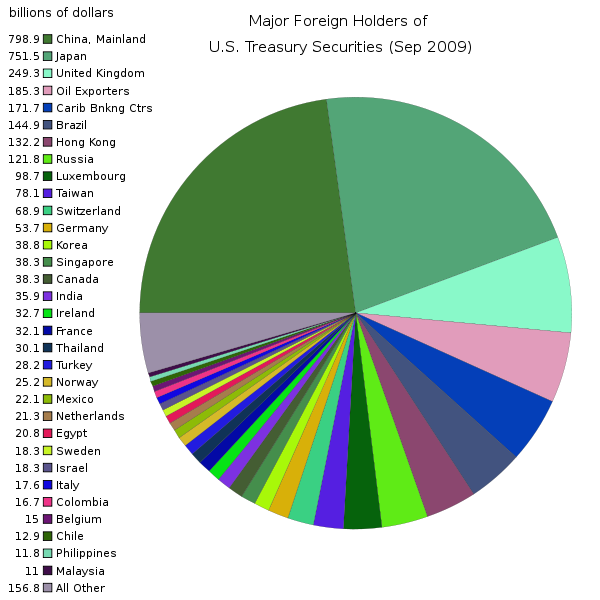
    we dont even own the us anymore china holds more money of ours then anyone else and to still be giving others help when we cant even help here at home is crazy

    there saying that we could owe as much as a quadrillion dollars in 10 years

    and china and japan would would own are country

    but hey lets give away free cash to anyone with troubles lets give free money to people who move here from other countries lol at this point the only way were going to get out of debt is to sell of a land we own

  34. #34
    Join Date
    Nov 2004
    Location
    Middle East
    Posts
    3,511
    I have an idea...Don't live in an area where it is prone to natural disasters. Kind of like the assholes who live in tornado country and then bitch when their house gets blown away.

  35. #35
    Join Date
    Oct 2009
    Location
    USA
    Posts
    1,180
    we owe this amount of money due to the fact we transitioned OUT of a manufacturing country, we no longer can produce competitive goods because we actually care enough to pay our people good standard of living wages (that plus unions sucked us dry). We need to find a niche for our country to bring in cash.

  36. #36
    like it or not you donate with every dollar you earn or spend.

  37. #37
    Join Date
    Aug 2004
    Location
    newport richey fl
    Posts
    1,931
    look at all the schools closing fire depts closing police stations closing and all the rest of the jobs closing or out sourcing because its cheaper hell in florida you cant even sell your house without taking a huge loss otherwise it can sit on the market for years

    if we took 10 years to just work on us here we would be close to out of debt stop jobs from out sourcing if the job can be done here

    and the biggest thing that gets on my nerves is athletes

    1. Tiger Woods

    Earnings: $100 million, Sport: Golf, Nationality: American, Born: Dec. 30, 1975

    As the face of Nike Golf, Woods has helped create a brand with $600 million in annual revenue for Phil Knight's company. No wonder they named a building for Woods on the Nike campus.

    2. Oscar De La Hoya

    Earnings: $43.0 million, Sport: Boxing, Nationality: American, Born: Feb. 4, 1973

    The Golden Boy has been the biggest draw in boxing over his long career. Revenues for his 18 pay-per-view fights totaled $612 million, the most in boxing history.

    3. Phil Mickelson

    Earnings: $42.2 million, Sport: Golf, Nationality: American, Born: June 16, 1970

    Phil the Thrill's income has surged in recent years as sponsors look for an alternative to Tiger in the golf sponsorship game. Callaway, Ford and Bearing Point write Mickelson his biggest checks.

    4. Kimi Raikkonen

    Earnings: $40 million, Sport: Auto racing, Nationality: Finish, Born: Oct. 17, 1979

    Ferrari made Raikkonen the highest-paid driver in motor sports last year when they gave the Finn a 3-year deal. Raikkonen delivered this year when he clinched the Formula One championship earlier this month.

    5. Michael Schumacher

    Earnings: $36 million, Sport: Auto racing, Nationality: Germany, Born: Jan. 3, 1969

    Formula One's greatest driver retired last year after dominating the sport for 15 years and winning seven championships. During his career, Schumacher earned $650 million in salary and endorsements.

    6. David Beckham

    Earnings: $33 million, Sport: Soccer, Nationality: British, Born: May 2, 1975

    Becks invaded America this year greeted by much fanfare, but injuries kept him off the pitch for most of the MLS season. The bulk of Beckham's income is derived from sponsors like Adidas , Motorola and PepsiCo

    7. Kobe Bryant

    Earnings: $32.9 million, Sport: Basketball, Nationality: American, Born: Aug. 23, 1978

    The possibility of the Los Angeles Lakers trading Bryant promises to be one of the biggest stories of the NBA season. Bryant will have a say where he goes, as he possesses the league's only full no-trade clause.

    8. Shaquille O'Neal

    Earnings: $31.9 million, Sport: Basketball, Nationality: American, Born: March 6, 1972

    Injuries caused the Diesel to average career lows in points and rebounds last season. Injured or not, the Miami Heat still owes Shaq $60 million over the next three years.

    9. Michael Jordan

    Earnings: $31 million, Sport: Basketball, Nationality: American, Born: Feb. 17, 1963

    MJ has been out of the NBA as a player for four years now, but his Jordan brand is still a $500 million a year sales business for Nike. Jordan is back in the league as a minority owner of the Charlotte Bobcats.

    10. Ronaldinho

    Earnings: $31 million, Sport: Soccer, Nationality: Brazilian, Born: March 21, 1980

    The two-time FIFA Player of the Year has lucrative endorsement contracts with EA Sports, Lenovo and PepsiCo, but Nike is his biggest deal. His current contract with the Barcelona club runs through 2010

    add that up 420.5 million and thats per contract per fight and per year
    and this doesnt account for endorsements they have gotten

    and what gets me is the fact if we added up there life time earning we would be out of debt

  38. #38
    Join Date
    Apr 2002
    Posts
    4,130
    Quote Originally Posted by cgb6810 View Post
    I read it was 46% but yeah it's down. Read the news.
    Are you saying you read it in the news, or telling me to read the news?

  39. #39
    Join Date
    Oct 2006
    Location
    ShredVille
    Posts
    12,572
    Quote Originally Posted by thegodfather View Post
    I have an idea...Don't live in an area where it is prone to natural disasters. Kind of like the assholes who live in tornado country and then bitch when their house gets blown away.
    I only complained because all my Express clothes and Aldo shoes you told me to buy got blown away and now some dude in Iowa is probably pimping my new clothes at da club.
    “If you can't explain it to a second grader, you probably don't understand it yourself.” Albert Einstein

    "Juice slow, train smart, it's a long journey."
    BG

    "In a world full of pussies, being a redneck is not a bad thing."
    OB

    Body building is a way of life..........but can not get in the way of your life.
    BG

    No Source Check Please, I don't know of any.


    Depressed? Healthy Way Out!

    Tips For Young Lifters


    MuscleScience Training Log

  40. #40
    Join Date
    Apr 2002
    Posts
    4,130
    Quote Originally Posted by Mooseman33 View Post
    ur wrong, obama has the lowest approval rating of any first year president.

    he is the next carter, and thank god a republican will walk back into the white house.
    No, I'm not wrong. He said that Obama has the lowest approval rating of any president in history. Which IS wrong. Bush was all the way down to 25%, which is half that of Obama. According to the Gallup poll, Obama is right around 50% right now. And you're wrong anyway if you wanna talk about first-year approval ratings. Reagan's approval ratings were lower at the start of his second year than Obama's are.

    The fact is, 50% is 50%. What's the difference if it's his first year or eighth year? His lowest approval rating is still higher than the lowest approval rating of every president since Kennedy.


    "Get your facts first, then you can distort them as you please"

Page 1 of 2 12 LastLast

Thread Information

Users Browsing this Thread

There are currently 1 users browsing this thread. (0 members and 1 guests)

Posting Permissions

  • You may not post new threads
  • You may not post replies
  • You may not post attachments
  • You may not edit your posts
  •