


Anybody else got anything to add to this?
There's a lot interesting info here and Marcus aswell as others have gone though a great deal of research to present that to the board.



 "cool as shit and knows his stuff"

Anybody else got anything to add to this?
There's a lot interesting info here and Marcus aswell as others have gone though a great deal of research to present that to the board.
 Knowledgeable Member
What's life about? Well life is about evolving, much like this thread has! Will be reading the last couple pages to see what i've missed in that time.
I do hope things didn't get too heated. I know 405 and BG are men of faith and it may have looked as if some of us, myself included, may have imposed some of the science a little too heavily!
 Senior Member
Damn Marcus, thanks for all the information you never fail to impress.
New Member
This thread looks like it deviated a bit from the original post LOL.
I had a massive existential hangover for many years in high school and college. I've studied and traveled a lot to learn about different world philosophies and religions, and have spent a few years in Hinduism, Taoism, Catholicism, Christian Evangelism, Islam, and even Zoroastrianism, and even went through a phase of Atheism. I've settled on Christianity and Buddhism (I believe in salvation through Christ AND the teachings of Siddhartha).
I had a troubled childhood to begin with. I'm not blaming my choices on circumstance, but it does go to note that in between the adoption system, an overwhelming amount of child abuse, and an inner-city upbringing, I had a lot of reasons to be 'messed up'. For a long time I was depressed, overweight, unmotivated, antisocial, suicidal, substance abusive, and extremely cynical. I kept trying to wrap my head around the Universe and understand myself. I drove friends and family away and lost my home. (this was near the end of highschool). I spent two years out on the streets trying to put myself together. Somewhere in the middle of all that I tried my hand at asceticism. For anyone who doesn't know, that's the buddhist/hindi notion of setting aside worldly desires and trying to separate one's mind from the body.
Once I understood why I felt the way that I did, and began to see the world for what it was, I could finally take the first steps that I wanted to take. I had nothing that made or limited decisions for me, because I was able to truly start with nothing. Every decision I made directly impacted my life, and they were MY decisions. From then until now (about 4-5 years), I went back and...
-finished high school, received almost a full-ride to the University of Michigan
-lost the remaining 200 lbs
-became passionate about new hobbies (including lifting & overall fitness)
-connected with old friends and made new ones
-reached out to everyone that I hurt during my depression and made amends
-began speaking at public events and reaching out to people my age
-found a career I can appreciate and find fulfillment in
-met the love of my life (4 years and still going)
In the end, none of us are born with a purpose. We create a purpose for ourselves using the experiences, memories, and passions that we come by through just living. I've calmed down a lot since my teenager years, and I've come to learn that the purpose I've made for myself is to reach out to others and help them find theirs. In our darkest moments, when we have nothing, we are given the rare opportunity to start everything over. That's one lesson I live by everyday, and make no regrets in anything that I do.
Last edited by fitizens_united; 04-17-2013 at 02:53 PM.
 Pissing Excellence!
Here is something I stumbled onto today. It is Stephen Hawkings discussing the origin of the universe.
http://www.google.com/gwt/x?u=http:/...dvYHoAg&wsc=bf
 ~Retired~ AR-Platinum Elite-Hall of Famer ~
Havent got time to reads this but will do later today thanksOriginally Posted by 00ragincajun00

"cool as shit and knows his stuff"
Extract from the article discussing M theory
M-theory posits that multiple universes are created out of nothing, Hawking explained, with many possible histories and many possible states of existence. In only a few of these states would life be possible, and in fewer still could something like humanity exist. Hawking mentioned that he felt fortunate to be living in this state of existence.
Great read
Professor Hawking is amazing
I agree with m theory
I believe there will be life out there and that we come from the singularity
Pissing Excellence!
Aliens!!!!!!!!!!!!!!
 Member
I really want to be strong, every day that passes by this feeling keeps growing I don’t want to be cut up or in comp shape anymore. I just want to be in the elite category with my strength. I have a long way to go but since I am only 27 I think I can get there I hope so . Also to always be a man of my word that comes before anything.
"cool as shit and knows his stuff"
http://forums.steroid.com/anabolic-l...nets-date.html
Interesting read also
"cool as shit and knows his stuff"
Just stepping back a few pages and some people choose not to agree in the singularity or the Big Bang that's fine
Some members believe a higher being or god created the known universe as it stands and everything in it this to is fine.
I have a question about creationism
Did it stop after gods 6 days of work?
Or is the the creating infinite?
The only reason I ask is if it is indeed infinite why does the bible state 6 days?
And I wonder if anybody can explain this picture?
Yet again this isn't an attack on religion I just need to get a broader understanding that is all.
"cool as shit and knows his stuff"
Always about the aliens with you isn't it
Lol
Pissing Excellence!
aliens and women!!!!!!!!!!!!!!
~Retired~ AR-Platinum Elite-Hall of Famer ~
Very interesting stuff been posted, keep it up love reading it
"cool as shit and knows his stuff"
Dr. Kaku: In Stephen's new book, he says that the Theory of Everything that Einstein spent 30 years of his life chasing is string theory (or its latest incarnation, M-theory).
In string theory, we have a multiverse of universes. Think of our universe as the surface of a soap bubble, which is expanding. We live on the skin of this bubble. But string theory predicts that there should be other bubbles out there, which can collide with other bubbles or even sprout or bud baby bubbles, as in a bubble bath.
But how can an entire universe come out of nothing? This apparently violates the conservation of matter and energy. But there is a simple answer.
Matter, of course, has positive energy. But gravity has negative energy. (For example, you have to add energy to the earth in order to tear it away from the sun. One separated far from the solar system, the earth then has zero gravitational energy. But this means that the original solar system had negative energy.)
If you do the math, you find out that the sum total of matter in the universe can cancel against the sum total of negative gravitational energy, yielding a universe with zero (or close to zero) net matter/energy. So, in some sense, universes are for free. It does not take net matter and energy to create entire universes. In this way, in the bubble bath, bubbles can collide, create baby bubbles, or simple pop into existence from nothing.
This gives us a startling picture of the big bang, that our universe was born perhaps from the collision of two universes (the big splat theory), or sprouted from a parent universe, or simply popped into existence out of nothing. So universes are being created all the time. (But Hawking goes one step farther and says that therefore here is no need of God, since God is not necessary to create the universe. I wouldn't go that far. See a previous blog entry on my attitude towards that.)
An extract from
http://bigthink.com/dr-kakus-univers...out-of-nothing
Last edited by panntastic; 04-20-2013 at 02:32 AM.
"cool as shit and knows his stuff"
The Universe Could Not Have Been Created by God Logic Versus Supposition
The existence of God is not enough to explain the existence of the Universe. If it is valid to say "everything has a cause except God", it is more likely that everything has a cause except the Universe. If God doesn't need a cause because it is infinite, it is more likely that the natural Universe has existed forever and therefore doesn't need a cause.
Everything Must Have a Cause (Except One Thing)
The Complexity of God and the Simplicity of the Natural Laws
The Existence of God is Not Enough to Explain the Universe
God Doesn't Need a Cause Because It Has Existed Forever
The Nature of God's Thoughts
Logic Must Predate the First Cause
Saying God is 'Outside' Logic
Conclusions
1. Everything Must Have a Cause (Except One Thing)
People who believe in god (theists) subscribe to the theistic idea that the Universe was the work of a creator-god. They say that 'god did it', and although many books have been written about the details, there are fundamental problems with the whole idea that a god created the Universe.
They say that all things must have a cause, and therefore, god exists as the 'first cause' of everything else. These people ask questions like "Who do you think created you?" and "Do you think the Universe came out of nothing... who do you think created it?". These types of questions both rely on the "everything must have a cause, therefore God exists" argument. But this argument doesn't work. Examine these points:
If god-believers say that 'everything must have a cause' and state that this means that god exists, then, they have missed a part of their declaration out. Their true belief is that "everything must have a cause, apart from God". The term for God as the cause of everything is the 'first cause', so, this is the same as saying "everything must have a cause, apart from the first cause".
God isn't a simple thing; it has thoughts, motivations (to create, to love, etc), it has powers, imagination and its thoughts are themselves ordered logically and coherently so that it can plan things and think about things in a sensible way. In short, God is quite a complicated being.
These two facts combined to produce the more accurate first-cause argument:
Theists believe that everything must have a cause, apart from the complicated self-created first-cause that has a coherent internal logic.
This means that the "everything must have a cause" part of the argument must be wrong. It is not true that everything must have a cause. In a causal world, there must always be something that has no cause. There is a different word for the belief that a complicated self-created first-cause that has a coherent internal logic requires no first cause: atheism.
This means that the "everything must have a cause" part of the argument must be wrong. It is not true that everything must have a cause. In a causal world, there must always be something that has no cause. There is a different word for the belief that a complicated self-created first-cause that has a coherent internal logic requires no first cause: atheism. Because if such a complicated thing can exist without a cause, then that first-cause could well be an atheistic Universe, complete with a few internal physical laws. If you argue that everything has a cause except for god, then, you might as well argue that everything has a cause except the universe, and admit that there is no need to theorize that God exists. So if you accept the first-cause argument then it does not prove that God exists, but instead it proves that the Universe could be without a creator at all.
2. The Complexity of God and the Simplicity of the Natural Laws
Some philosophers have even realized that God is more complicated than an uncaused Big Bang. When it comes to comparing arguments where there is no hope of actually getting any physical evidence, there is a long-standing heuristic to help distinguish between theories, called Occam's Razor: it turns out that when all evidence is accounted for, the simpler of any two theories is more likely to be the correct one. The theory with fewest assumptions is more likely to be true. God requires many properties and complexities such as consciousness, thought, personality, creative drive, love, an internal logic ordering its thoughts so that it can think coherently and rationally, etc: All of these properties must have been derived from somewhere. It turns out that God is a vastly more complicated thing that the Big Bang and the fundamental laws of the Universe.
"The scientist, however, may wish to challenge the assumption that an infinite mind (God) is simpler than the universe. In our experience, mind only exists in physical systems that are above a certain threshold of complexity [...] While it is possible to imagine a disembodied mind, there must be some means of expression of the pattern, and the pattern itself is complex. So it could be argued that an infinite mind is infinitely complex and hence far less likely than a universe. [...]
According to our best scientific understanding of the primeval universe it does indeed seem as though the universe began in the simplest state of all - thermodynamic equilibrium - and that the currently-observed complex structures and elaborate activity only appeared subsequently. It might then be argued that the primeval universe is, in fact, the simplest thing that we can imagine."
"God And The New Physics" by Paul Davies (1984)
There are fewer unanswered questions if we discard the complexities of a creator-god, and admit that atheism is more likely. If "everything must have a cause except for the first cause" then that first cause is much more likely to be an atheistic universe with its few basic laws, than a more-complicated creator-god.
3. The Existence of God is Not Enough to Explain the Universe
It is not enough to say that "God exists" as the explanation as to why the Universe exists. If a God created the Universe, then, why did it do so? God must have had thoughts - a creative impulse - to create the space-time continuum. Therefore it is the properties and thoughts of God that explain the Universe, not the mere fact that God exists. God could easily exist for all of its eternity, existing in perfection in a perfect world, without creating the Universe. So saying that God explains the existence of the Universe is not the whole story.
"If God has a plan for the universe, which is implemented as part of his will, why does he not simply create a deterministic universe in which the goal of the plan is inevitable? Or better still create it with the plan achieved?"
"God And The New Physics" by Paul Davies (1984)
Unfortunately there have been no comprehensive or compelling arguments as to why God created the Universe. This is a problem that effects not only monotheistic religions like Judaism, Christianity and Islam, but also other religions such as Buddhism: Sages from all these religions have tried to explained why existence is the way it is, complete with suffering and death, but none have given a straight answer as to why any of it needed to exist at all.
4. God Doesn't Need a Cause Because It Has Existed Forever
Some theists argue that God is eternal and was therefore never created. But I find this is an argument that can be used in conjunction with Big Bang theory to prove, again, that god is not likely to exist as a first cause. According to some Big Bang theories there has been an infinite number of cycles of Big Bang / Big Crunch (where the Universe ends in a big black hole after contracting, before exploding again) and that the Universe has existed forever. If it is possible for something to exist forever and not need a cause then it is likely to be the Universe, not God, and once again we can theorize that this is likely to be true because there would be no reason for god if it was true that something could exist with no cause.
5. The Nature of God's Thoughts
5.1. Logic Must Predate the First Cause
In order to create, to think, God's thoughts must be more than random. To create the universe and time, God must be able to think logically. If it can't think logically, then, the laws of the universe were simply random, and the Universe might as well been self-created in an atheistic manner. In other words, for God to exist, God's thoughts must have always been ordered in a logical manner otherwise God could never have created order from chaos.
This means that logic is a precursor to God. Logic, with its simple relations and rules that lets thought itself be ordered, must have existed independently of God's creative power. God could not have created the logic because requires logical thoughts to do any meaningful creating.
This results in two conclusions:
In theology-speak, the first cause is the description given to the creator of the universe, time, the laws of physics, etc. But it seems that in order for the first cause to be a creator-god, then that god cannot have created logic, and cannot therefore be the first cause after all. In other words, the fact that God needs to think logically in order to create means that God itself cannot be the creator of everything, only of parts of reality. In other words, there cannot be any monotheistic creator god.
If God chose to create anything then it must have had reasons to do so. God's "will" is not random, meaningless, chaotic or thoughtless. This means that these "reasons" are dependent on pure logic and must have driven god to do its very first act of creation. These motivations, this initial logic, will have been dictating God's thoughts from the moment of God's inception. If there was no logic and no motivation, God did not create anything on purpose. In that case, you might as well admit that the Universe created itself randomly, and that no creator God was required.
If god created anything according to a thought-out logical plan, or, if God had a desire to create anything that wasn't pure random chaos, then, god's thoughts must have been framed around logic. This logic allowed god to think and create, and, gave motivation to God. Logic must have been the first cause; but if logic is a requirement for God and existed before God could create, then God cannot be the First Cause, and therefore, creator-god theism is false, and atheism is true.
5.2. Saying God is 'Outside' Logic
Some theists will make assertions that god is "outside of outside", "beyond logic", "transcends logic", "not subject to logical limitations" or that "human logic is limited" and other similar argument-stoppers. Although this at first appears to throw all intellectualizing out the window, kick all theology out the front door and firmly garrison the houses of religion from debate, it actually opens up the theist to some further criticisms.
If "Human logic" is insufficient for metaphysics then debating for the existence of God is pointless. Because it is by Human logic, thought and mentality that we arrive at the concept of God in the first place.
If God behaves according to logic that we don't understand (i.e.: Human logic is limited) then God is still behaving according to logic, even if it is logic we don't understand.
To say that god doesn't obey logical rules, to say that God could create a round square, for example, is to say that the abilities of god are abilities that cannot logically exist, making God into fantasy.
"Beyond logic" is a synonym for "irrational", and admissions that beliefs are "beyond logic" is an admission that such beliefs are irrational and logically indefensible.
If God is beyond logic, is it not true that atheists are at least somewhat more rational and logical in their beliefs? It seems to be!
6. Conclusions
If God can make plans, think logically or exist, then logic is an arch-power that encompasses God and gives reason for god's existence which appears to refute the idea that God could be the creator of logic. The God as first-cause argument is partially undermined. If there is no logical reason why God exists then it is more likely that there no logical reason why the Universe exists, and that instead of assuming that the organisational force is a 'god', it's simpler and more rational to assume that it is the universe itself. It appears that whether God exists for logical reasons or not a fundamental contradiction occurs. The only answer is that creator-gods cannot possibly exist. Atheism is more logical. This is also true if God is placed "beyond logic". And if it is said that Human logic is incapable of realizing such metaphysical truths, then this also undermines any argument that can be made by one human to another, for the existence of god.
Theistic arguments that God is 'beyond logic' or at least, beyond human understanding, place God firmly into the territory of irrational fantasy. To retreat into the corner where logic itself is denied, god-believers have admitted that there is no logical basis for their belief. At this point, it is better to try to understand the idea of God in terms of human psychology.
 This means war!
^^^^^ best post ever.
"cool as shit and knows his stuff"
I found that this morning when doing some more research and was too good not to share on the thread
This means war!
Thanks for sharing, I would like to hear the theists arguments in reply to that, it seems like every argument for a god has been accounted for in that little collage.
"cool as shit and knows his stuff"
Marcus has really sent my mind into a bit of a spin with this thread
I'm not a smart man but I'm willing to learn and ask questions about what I see and this inquisitive nature is making me delve deeper into this subject
~Retired~ AR-Platinum Elite-Hall of Famer ~
Woooow keep reading over and over great posts
Knowledgeable Member
Marcus mentioned earlier about water.
I find water an incredible element for many reasons. It can exist in all 3 states and all life requires it.
Read recently that water throughout the Universe is formed when stars are born. Another report also showed that Scientists located a mega gas cloud surrounding a quasar some 12 billion light years away as having literally, trillions and trillions more mass than all of earths oceans. It also shows that water has pretty much been present since the Universe came into existence:
NASA - Astronomers Find Largest, Most Distant Reservoir of Water
Last edited by Flagg; 04-20-2013 at 12:55 PM.
"cool as shit and knows his stuff"
By far the deadliest thing going yet most necessary
Can fill any gap it gets into
Like you say 3 different states
Only need 2" to drown in it
We need it to live so does flora/fauna
We're made mostly of it aswell
Such an amazing element
Knowledgeable Member
I know it's Wikipedia, but check out the page: https://en.wikipedia.org/wiki/Water
I don't know how many people know this, but did you know, no one snowflake is ever the same. The chemical and physical properties of water are just simply amazing. And that's before getting to the biological properties of water!
Another fact about water, light become's attenuated in water and refracts. In other words it slows down as it is reflecting off of water molecules. Light also cannot penetrate something like 8 meters of water.
Knowledgeable Member
Another fact.
Rainbows are a optical illusion caused by light refracting off water droplets in the sky, which is why most rainbows occur just after it has rained. Even though rainbows can be filmed/photographed, they do not have a "physical location" and they are always directly opposite the sun when you see one.
"cool as shit and knows his stuff"
I knew about this
Did you know the earliest form of fibre optic cable came from an idea of light refracting through water?
In 1854, John Tyndall demonstrated to the Royal Society that light could be conducted through a curved stream of water, proving that a light signal could be bent.
Knowledgeable Member
I didn't actually know that, will be looking more into that mate
Virtually every aspect of science can be applied to water, physiques, chemistry, biology, environmental, medical, geology and so on. Just the amount of uses and what it can do is mind boggling. I mean it's amazing that water in it's liquid state can practically act like a mirror, though it can't "reflect" light.
"cool as shit and knows his stuff"
Looks like us Brits well and truly got this thread tied up lol
Knowledgeable Member
Another link some people in this thread might be interested in:
H2O - The Mystery, Art, and Science of Water
~Retired~ AR-Platinum Elite-Hall of Famer ~
Great reading and some very interesting things to think about, when you look at water it is an amazing thing and that's why I mentioned it earlier....
Have you done any research on origins of man? (DNA)
~Retired~ AR-Platinum Elite-Hall of Famer ~
Didn't know some of this stuff being posted. It's amazing and really does answer a lot. I'm still getting my head around the dna stuff I posted. Now I have all this to read
Knowledgeable Member
How Water Shapes DNA
"cool as shit and knows his stuff"
Here's an interesting one I never knew:
The earth is a closed system, similar to a terrarium, meaning that it rarely loses or gains extra matter. The same water that existed on the earth millions of years ago is still present today.
~Retired~ AR-Platinum Elite-Hall of Famer ~
What do you mean Pann, closed system?
"cool as shit and knows his stuff"
That's was a quote Marcus I found it when doing some research on water after Flagg posted them very interesting items.
I found it here:
http://www.allaboutwater.org/water-facts.html
But as you asked about closed system I got back onto google
And found this for you:
http://www.uvm.edu/~cmehrten/courses...d%20System.pdf
A quick extract from the PDF:
Material flows between reservoirs or sinks along pathways, or fluxes.
Examples: Water vapor in the atmosphere condenses and falls as rain and breaks down rocks. Ocean water evaporates into the atmosphere. Volcanoes erupt and spew water vapor into the atmosphere
~Retired~ AR-Platinum Elite-Hall of Famer ~
Interesting reading Pann, this thread has evolved aswell as man kind lol
Its like a educational thread on life
"cool as shit and knows his stuff"
A Very informative thread Marcus
Think its covered many areas in great depth aswell
 AR's Scrapple Lover
that it somethin to ponder
Anabolic Member
life is a learning process, it has its ups and down. Its not easy but we never said it was not worth living.
Knowledgeable Member
Regarding DNA, there's a reason virtually all life has identical DNA to each other.
I spoke about convergent evolution earlier but really, all life is related to each other, all life came out of the sea and EVERYTHING has a single, common ancestor.
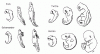
It's the same reason why the bone structures in many species are homologous. I mean look at this:
Look how similar the chicken and human embryo looks prior to full maturation. Fish, elephants, pigs, etc, all look nearly the same in the very early stages of development.
Here are some other examples:
There are currently 4 users browsing this thread. (0 members and 4 guests)
 Posting Permissions

 Reply With Quote
